KEP-1: Taclet-Generating Transformers
Status: proposal / proof-of-concept
This KEP describes an experimental feature that currently lives on a branch and in an open pull request. The design is settled enough to try out, but details may still change, and the feature may be reshaped before (or instead of) being merged.
- Realises a discussion from 2019: Taclet-Generation-Language
- Pull request: KeYProject/key#3893 — "RFC / KEP-1: Taclet-generating transformers"
- Scope of this page: the concept, how to use it from the GUI and the command line, and where the idea goes beyond the One Step Simplifier.
The idea
Several parts of KeY perform many calculus steps at once in Java code:
term transformers (metaconstructs such as #add, which computes an
integer sum during rule application) and built-in rules — the
One Step Simplifier (OSS) above all, which aggregates a whole fixpoint of
rewrite steps into a single proof node. While OSS shows you a protocol as certificate
what it has done, due to technical reasons, translating the protocol into a sequence of taclets to obtain an OSS free proof is hard (see KeYProject/key#3707). This means,
you have to trust a second rewrite engine to be correct. Meta constructs, program transformers and
other built-in rules do not provide any transparency and one has to trust the implemented Java code.
The big advanatage of these constructs is speed and the ability to express complex transformations.
This KEP explores a middle path. Instead of a transformer that mutates the proof directly, a lemma generator produces a specialized, metaconstruct-free taclet that captures the transformation at a concrete position. That taclet is
- introduced as a goal-local rule — a recorded proof step — and then
- applied as an ordinary, fully recorded taclet application, and
- provable: a soundness proof obligation is created for it and can be discharged like any other proof, in the base calculus.
The performed transformation becomes an inspectable, separately certifiable artifact, while proof search still runs at full speed where you want it to.
Two proof steps instead of one opaque step
Consider the propositional tautology
p & true & (q | true) -> true & p
With the One Step Simplifier enabled (the default), automatic proof search closes it in one aggregated step:
0: One Step Simplification
  1: closeTrue
The One Step Simplification node hides five individual rewrites. The proof
file records only the position; on reload, OSS re-runs the whole fixpoint and
trusts that the current rule base reproduces the same result.
With One Step Simplification set to Transparent, the same proof instead introduces and applies a generated lemma:
0: introduce_ossLemma
  1: ossLemma_fbf1a98ed8f4__0
    2: closeTrue
The introduced taclet is exactly the aggregated simplification, spelled out:
ossLemma_fbf1a98ed8f4__0 {
    \find( p & true & (q | true) -> true & p )
    \replacewith( true )
}
// aggregates 5 base-calculus steps
introduce_ossLemma is a built-in rule that only makes the taclet available
(the sequent is unchanged); the next node is an ordinary application of that
taclet. Both are recorded, so the proof replays without re-running the
simplifier, and the lemma can be proved sound on its own.
(Reproduce the trees above by loading the problem with One Step Simplification
set to Enabled and to Transparent respectively, and running the automatic
strategy.)
The framework
The mechanism is generator-agnostic. A LemmaTacletGenerator maps a position
in a goal to a taclet, subject to three contract requirements:
- Context-freeness. Any branch-local hypotheses the transformation relies
on must be made explicit as
\assumesclauses, so the taclet is globally sound and its obligation can be proved in the empty context. - Provability. The taclet must lie in the fragment the taclet soundness proof-obligation machinery supports — no variable conditions, no metaconstructs, no modalities.
- Determinism. Replaying the introducing step must regenerate an identical taclet, in particular the identical name.
The first generator is OssLemmaGenerator, which turns an aggregated
one-step-simplification F ↝ F' into a taclet.
Not all OSS steps are supported (yet) as all generated taclets should be provable using
KeYs Taclet PO generator.
A generated lemma's soundness obligation is created lazily (proof search never pays for it) and proved with the One Step Simplifier switched off. This ensures that rules are proven correct with the taclet proof engine. Otherwise, one would rpoof OSS with itself as it used behing the scenes by the OSS lemma generator to produce the replacewith formula of the taclet.
Using it in the GUI
1. Choose the transparent mode
Proof Search Strategy → One Step Simplification now offers a third value
besides Enabled and Disabled: Transparent.
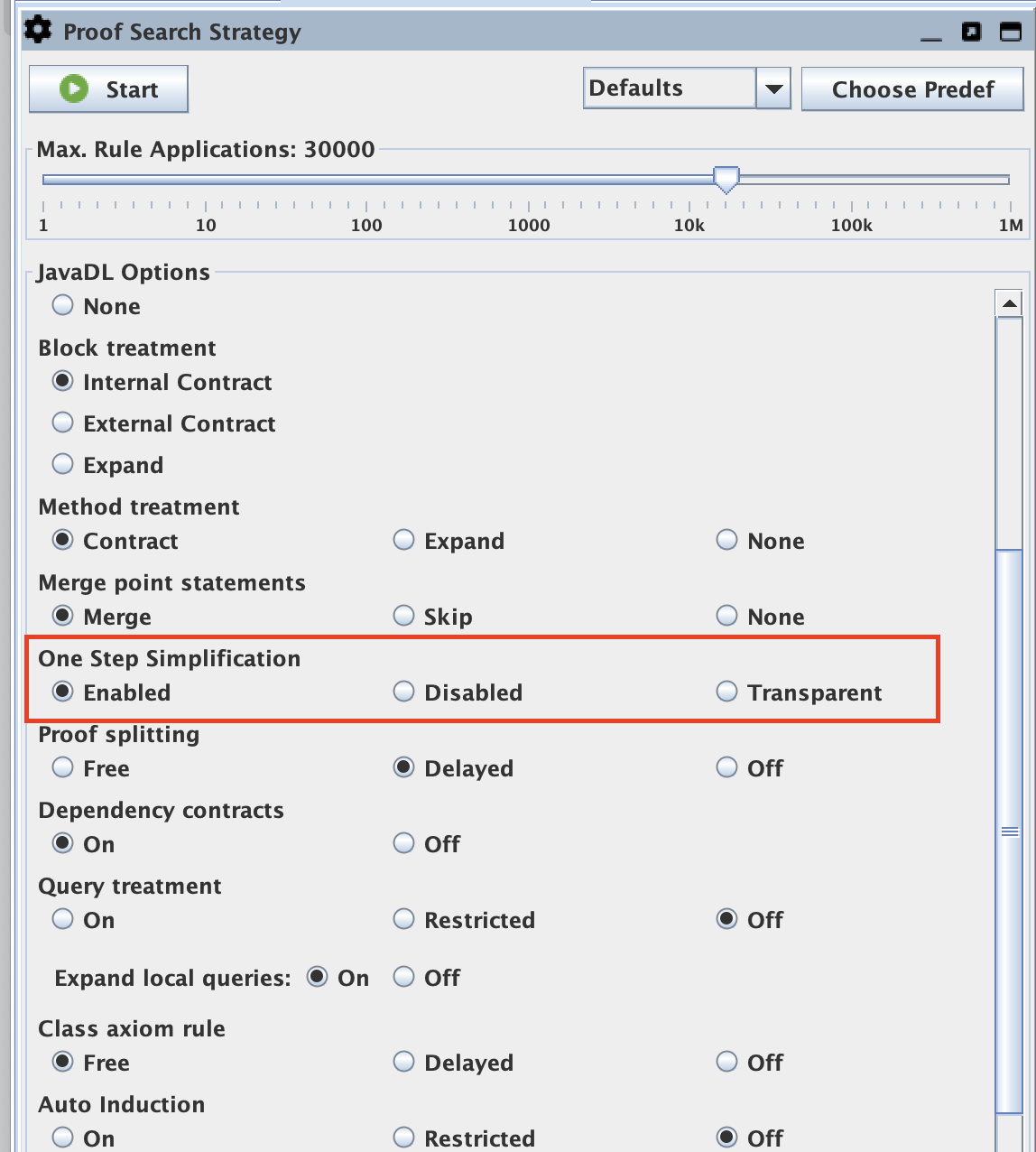
- Enabled — the classic opaque One Step Simplifier (fastest, least transparent).
- Disabled — no OSS at all; every simplification is an individual rule application (most transparent, largest proofs).
- Transparent — aggregated simplifications of modality-free formulas are performed via generated lemmas (inspectable and certifiable); formulas with modal operators are simplified by the ordinary calculus in individual steps. Proofs are fully transparent — they contain no opaque OSS step at all — but larger, and search is somewhat slower.
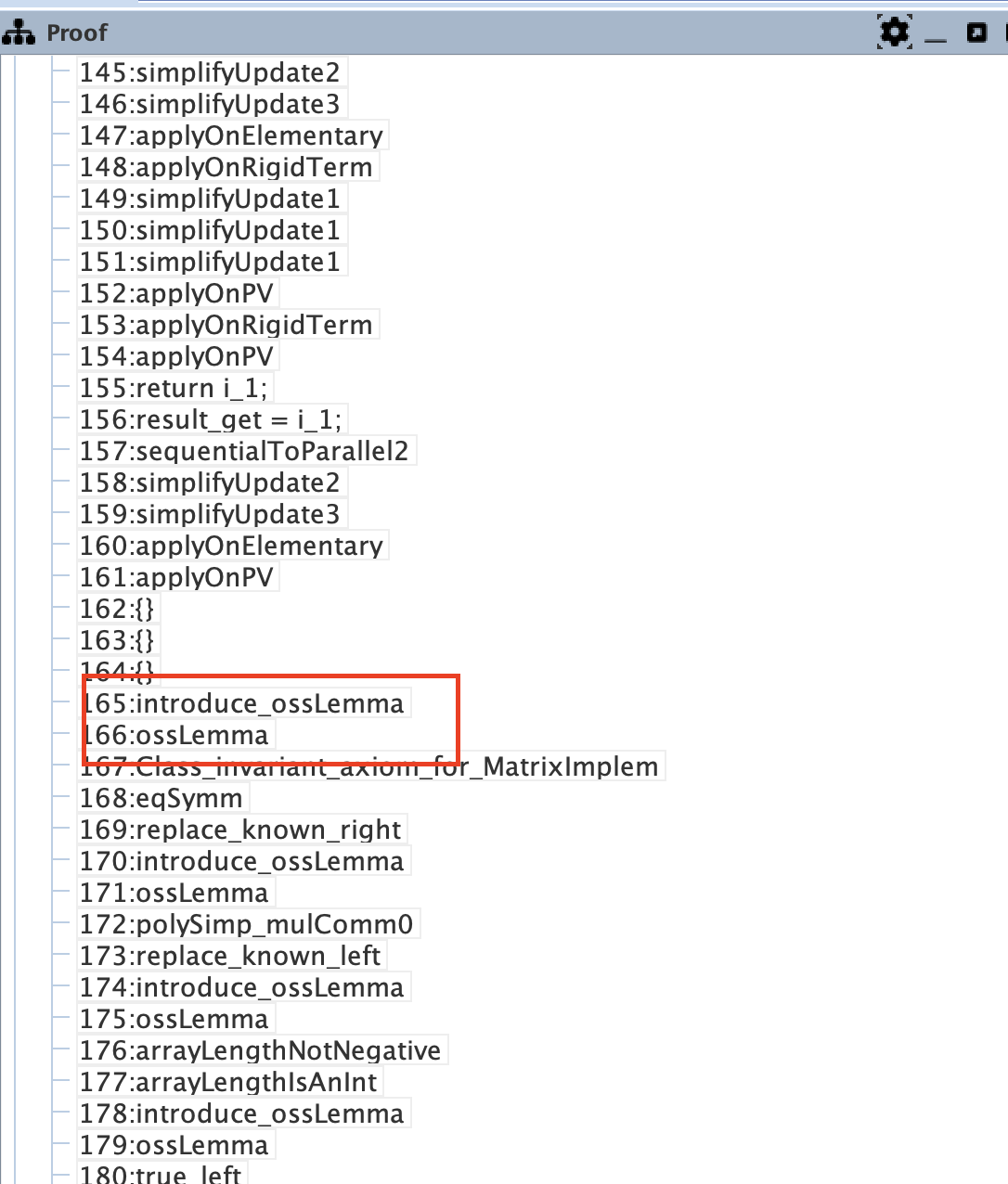
Run the automatic strategy as usual. The proof tree now shows
introduce_ossLemma / ossLemma_… pairs instead of One Step Simplification
nodes; clicking a generated taclet shows its full \find / \replacewith.
2. See and prove the lemmas a proof depends on
A proof that used generated lemmas is closed only modulo those lemmas until their soundness obligations are discharged — its status is closed but lemmas left. To inspect and discharge them, open Proof Management (the proof-obligation browser), select the proof under By Proof, and switch to the new Lemmas tab.
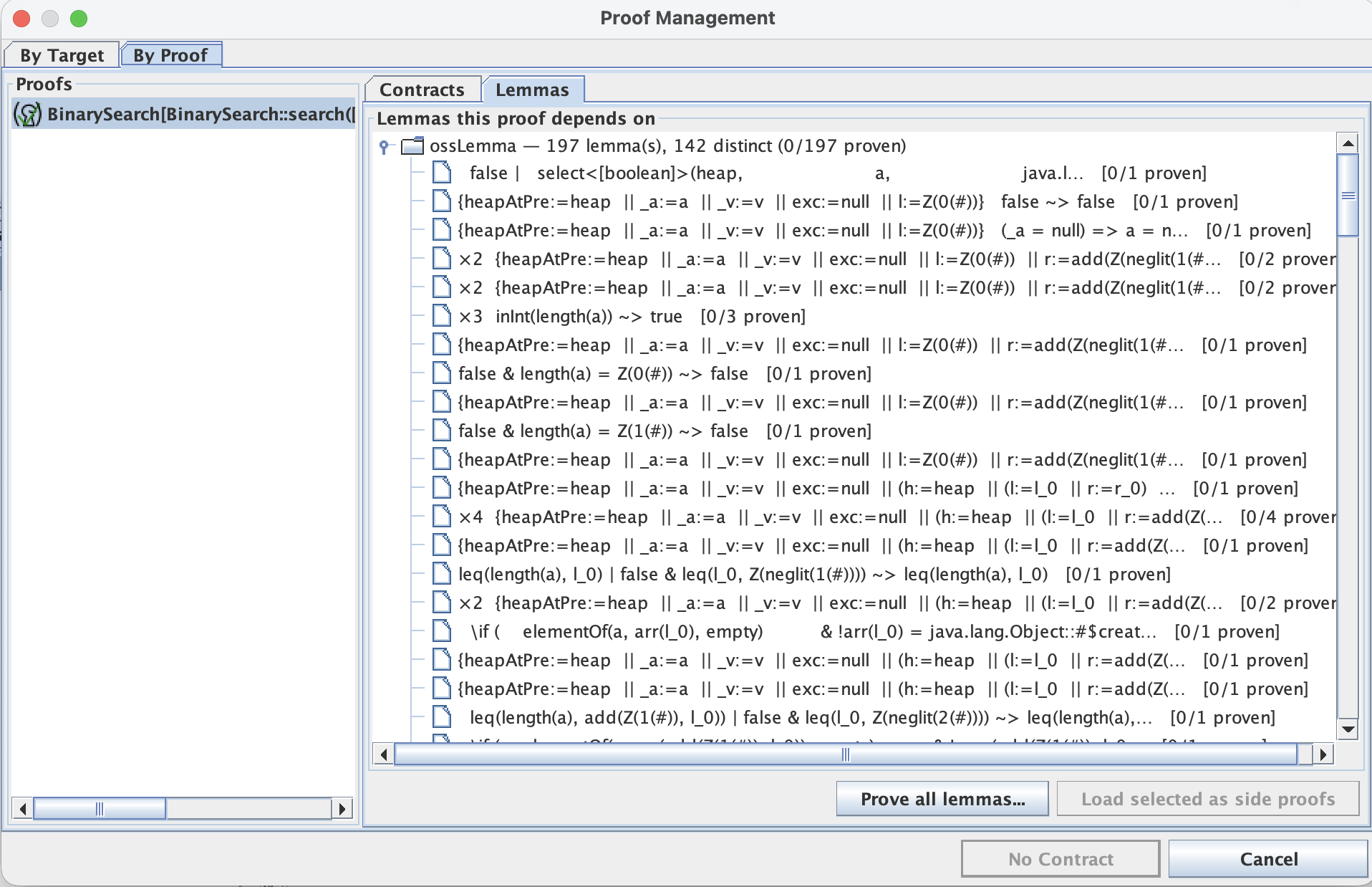
The lemmas are grouped by generator and, within a generator, collapsed
by content, so that the many introduction-point-distinct instances of the
same simplification appear as one row with a count and a proven/open status.
(On a real proof this matters: verifying BinarySearch in transparent mode
generates on the order of two hundred lemmas that collapse to a few dozen
distinct simplifications.)
From here you can
- Load selected as side proofs — bring the selected lemmas' obligations into the task tree as ordinary proofs to work on them interactively, or
- Prove all lemmas… — batch-discharge every obligation with an automatic step bound (obligations that do not close within the bound stay open for manual work), optionally saving each obligation proof to a directory.
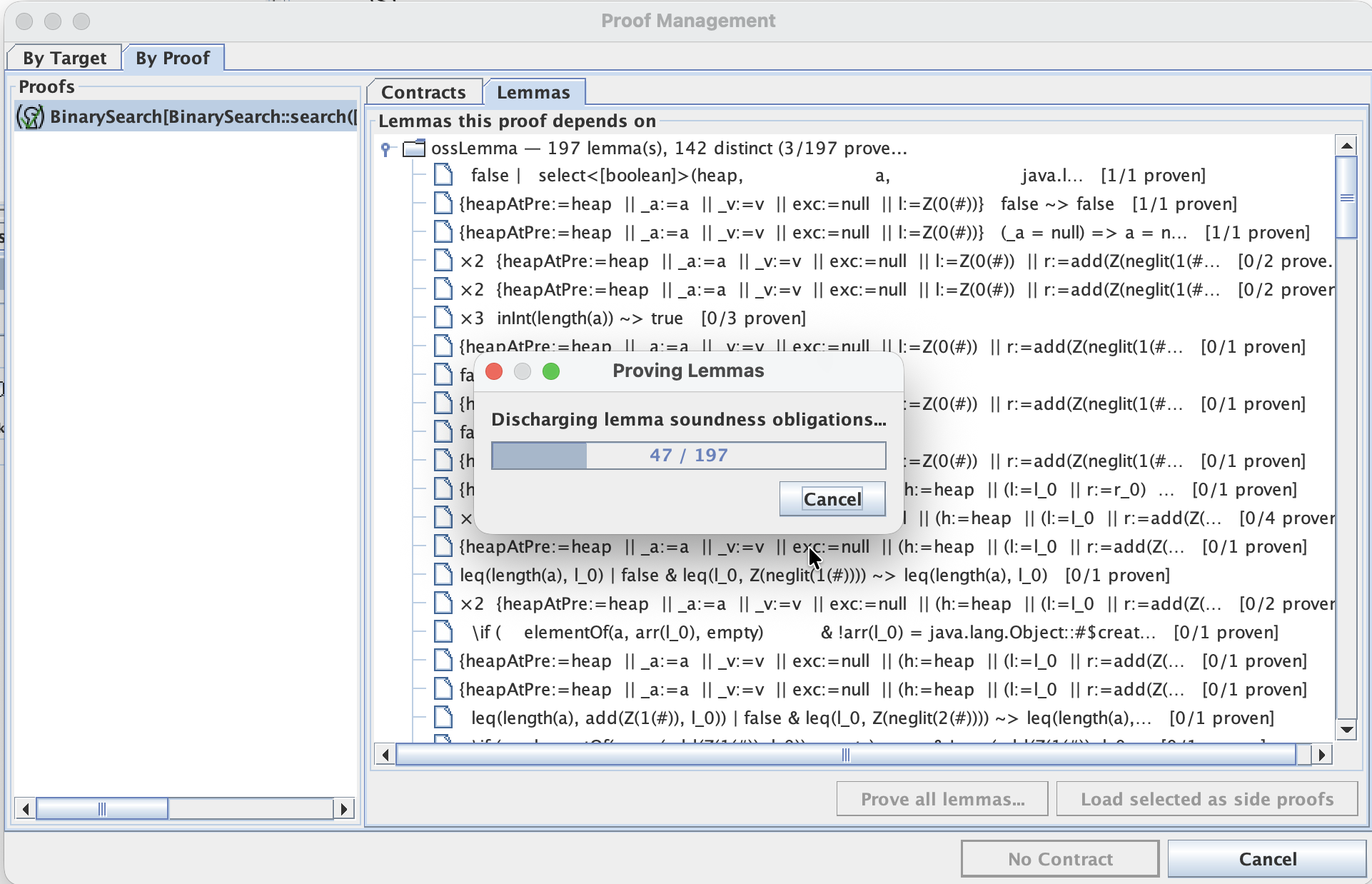
Batch proving shows a progress dialog with a cancel button. Obligations that close are certificates and are not added to the task tree (so a batch over many lemmas does not flood it); only obligations that remain open are surfaced for manual completion. Once all obligations are discharged, the proof's status turns from closed but lemmas left to closed.
Cleaning up bulk-loaded side proofs
If you load many lemmas as side proofs, you can drop them all at once: right-click the environment node in the Loaded Proofs tree and choose Abandon All Proofs of Environment.
Saving a transparent proof
Two entry points produce a proof in which OSS aggregations are elaborated into generated lemmas:
- GUI —
File → Save Transparent Proof…, also available from the task-list context menu and from the proof-closed statistics dialog. A proof found with the fast opaque simplifier is elaborated onto a fresh proof in which every eligible OSS step is replaced by an introduce/apply lemma pair, and that proof is saved. The original proof is untouched. - Command line —
--save-transparentwrites<file>.transparent.proofnext to the ordinary batch-mode output.
Loading a transparent proof replays the recorded introduce/apply pairs. The generated taclets are not yet stored in the proof file; replay regenerates them from the recorded step (their content-derived names make this deterministic). Serializing the taclets into the file — so that a checker needs only the taclet text and its obligation, with the generator out of the trusted base — is a natural next step, deliberately out of scope for this proposal.
Beyond the One Step Simplifier
The One Step Simplifier is the first and most rewarding generator, but the framework is not tied to it.
-
Other term transformers and rewrite-shaped built-in rules. Any transformation that produces a ground, modality-free rewrite
t ↝ t'can be packaged the same way. The proof-of-concept includes a deliberately tiny generator for integer-literal addition (the#addmetaconstruct analogue), used only to validate the framework end to end. -
A posteriori elaboration. The same generators drive a second mode: find a proof with the fast opaque rules, then elaborate the finished proof into a transparent one (this is what "Save Transparent Proof" does). Search stays fast; transparency is produced on demand afterwards.
-
Certification and reuse. Because a generated lemma is a real taclet with a real soundness proof, the same simplification recurring across branches can in principle be captured once and reused — a first step towards a library of proven, proof-derived lemmas. Serializing generated taclets into proof files, and sharing them across proofs, are the obvious follow-ups.
-
Program transformers stay justified-by-construction. Transformations whose result contains modalities (for example inserting a jump or otherwise rewriting a program) fall outside the provable-taclet fragment; for those the opaque, justified-by-construction path remains, and this KEP does not change them.
Notes and limitations
- Transparent mode is explicitly a pay-for-inspectability mode: the symbolic-execution and update-simplification parts of a proof run at roughly the "OSS off" cost, while the FOL/heap bulk is still aggregated into lemmas.
- The soundness-obligation fragment for taclets is what bounds applicability: modality-free find formula (including update-laden ones) are lemma-eligible; find formulas containing program modalities are not.